English

SAIFUKUJI TEMPLE

A place where prayer has never ceased. Where architecture, garden, and faith breathe as one.
Founded in 1368. A living temple of prayer.

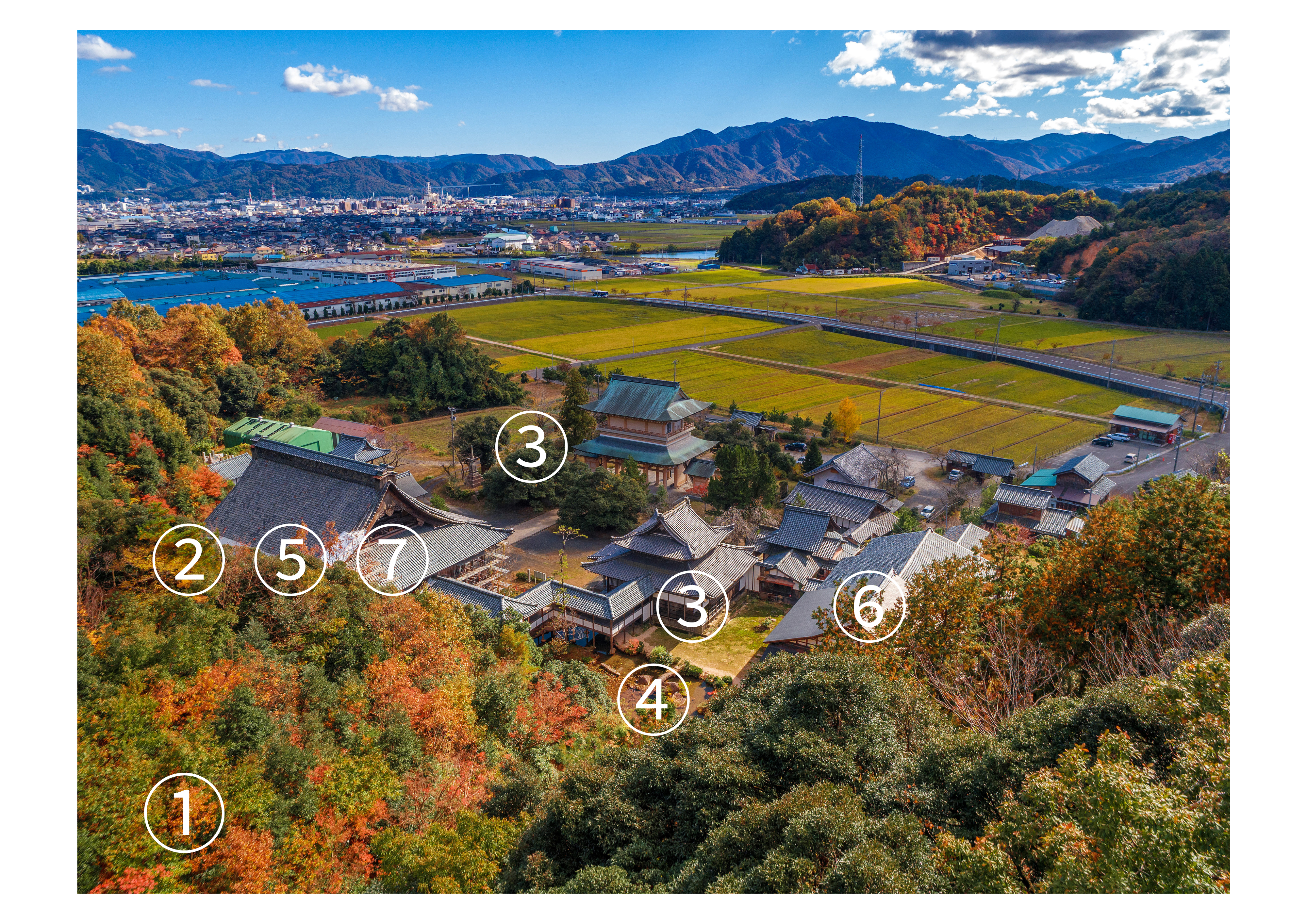
The Seven Mysteries of Saifuku-ji
These seven mysteries were not created to attract visitors.
They have quietly lived here, passed down through prayer, memory, and daily life.
Some have stories. Some have explanations. And some remain unanswered.
They are not meant to be solved. They are meant to be encountered.
These mysteries did not arise by chance. They were shaped by history, belief, and a space created for Pure Land devotion.

History & Identity
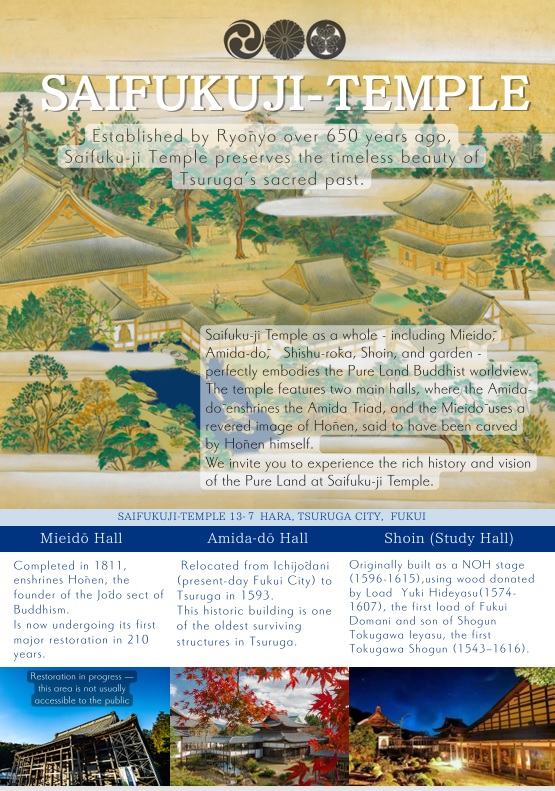
Founded in 1368, Saifuku-ji has long served as a place of prayer supported by emperors, shoguns, and those who carried responsibility for the age.
It was established as an imperial prayer temple, and over the centuries, its halls were maintained through the support of the Ashikaga shogunate, court nobles, and later, samurai leaders of the region.
Rather than standing at the center of political power, Saifuku-ji remained a place where prayers were entrusted— for peace, for stability, and for the settling of troubled times.
Prayer here was never for display, but for continuity.

Architecture & Garden
At Saifuku-ji, belief is expressed not only through words, but through space itself.
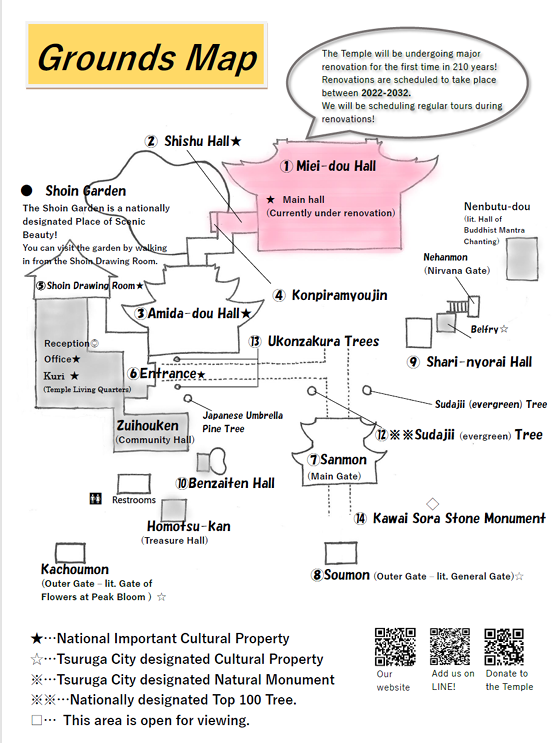
To the east stands the Founder’s Hall, enshrining a statue of Honen Shonin. To the west lies the garden, said to represent the Pure Land.
Between them, the visitor walks a path shaped by faith— a composition that quietly teaches that through nembutsu, one is guided from this world toward peace beyond.
The temple holds two main halls, a rare architectural form that reflects its spiritual role.
The garden, designated as a Place of Scenic Beauty, is believed to embody the welcoming descent of Amida Buddha and the bodhisattvas.
Here, architecture does not impress. It reassures.

Experiences
Experiences at Saifuku-ji are not performances. They are moments of participation in a living practice.

Sutra Copying(Shakyo)
Sutra copying is offered as a quiet practice of prayer and reflection. To ensure a calm and respectful setting, this experience is available by advance reservation only.
Participants are guided through the practice in silence, focusing not on technique, but on breath, attention, and repetition.

Tea with a Garden View
Following sutra copying, tea may be offered in a quiet space overlooking the garden.
This experience requires preparation and is therefore available by advance reservation only.

Training Program (Shuyo-e)
Saifuku-ji offers a structured training program for groups, including chanting, a Dharma talk by the head priest, temple service, and sutra copying.
As this program involves preparation and coordination, participation is available by advance reservation only.
All experiences require advance reservation to preserve the quiet rhythm of the temple.
Reservations
To request a reservation for experiences at Saifuku-ji, please use the online form below.

[Reservation Form]
Now Preparing
The reservation form for Shakyo (Sutra Copying) and Shugyō Retreat is currently under quiet preparation. Please visit us again.

Supporting the Restoration
Much of Saifuku-ji’s architecture has been designated as Important Cultural Property. A long-term restoration project is currently underway to preserve these historic structures for future generations. Those who wish to support this effort are invited to take part in the temple’s restoration activities. Contributions are received with gratitude and are used solely for preservation and repair. To support this work is to help carry prayer forward in time .


The Seven Wonders of Saifukuji Temple


Saifukuji Temple’s chief priest has put together an explanation of the Seven Wonders.
We hope you will enjoy your time exploring them all.
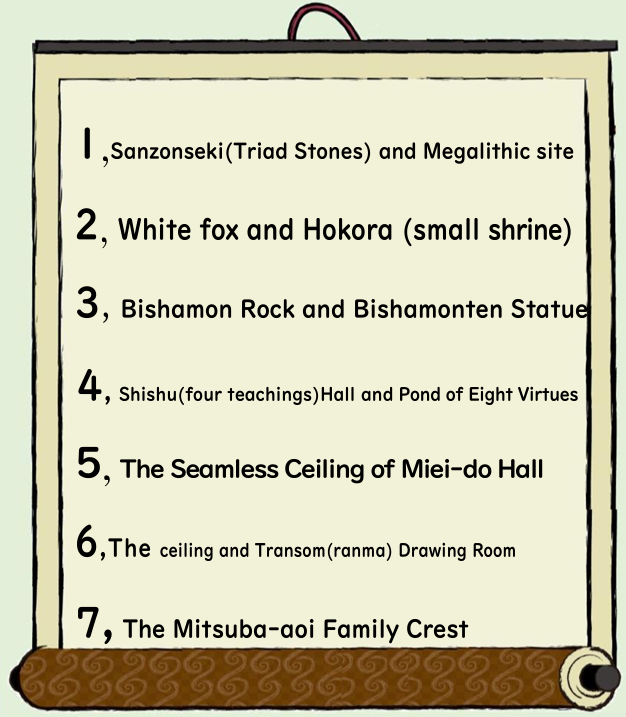


一、 Sanzonseki(Triad Stones) and Megalithic site

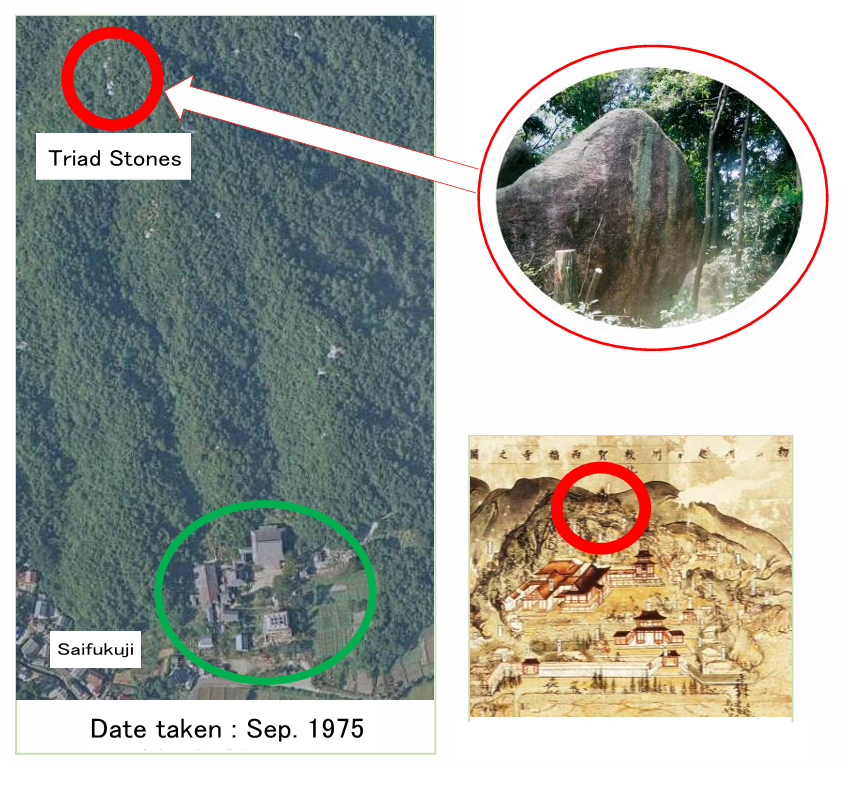
 Triad Stones are the historic stones on which Saifukuji-Temple was built. Thecharacters that represent Buddha’s name, Namu Amida Butsu(南無阿弥陀仏)are carved into the stones. The garden the stones populate represents a Buddhist saintwho leads the dead to the Nirvana.

 It is believed that when Ryonyo, the founder of a temple, visited Tsuruga Port on hispilgrimage, he saw Amida Snson – a set of three Buddhist deities- standing in thelight, followed it to this place, where Sandon deities turnedinto large stones.

 Ryonyo decided to build the temple, Saifukuji-Temple was then built after receiving imperial sanction.

 The surrounding mountains are also full of megaliths with mysterious legends.


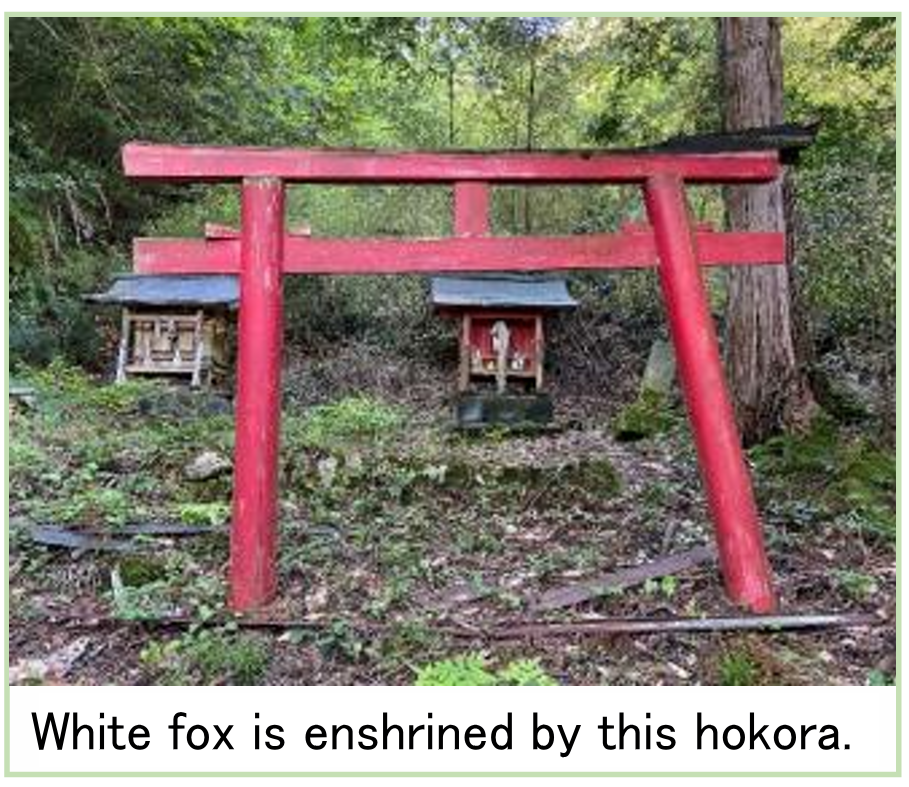
二、 White Fox and Hokora (small shrine)


 It is said that when Ryonyo came to this place followingthe light, a white fox appeared and lead him to thisfoothill.

 It is believed thatsucceeding chief priests areguided by the white fox.
The white fox is enshrinedby this hokora, or smallshrine.


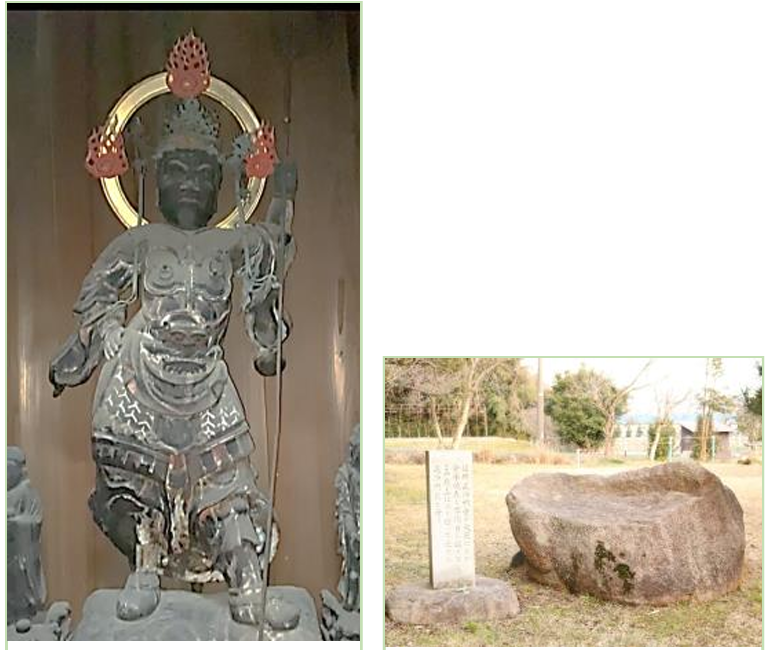
三、Bishamon Rock and Bishamonten Statue

 This Bishamonten statue, created bythe priest Ryonyo, was previouslyenshrined in another Buddhisttemple. When that temple wasdestroyed by a fire, the statue ranaway by itself to stand on this rock,which is now called Bishamon Rock.


四、Shishu(four teachings) Hall and the Pond of Eight Virtues


 Honen the founding figure of the Jo do-shiu (lit. pure land) branchof Buddhism, states that everyone can be saved by reciting “NamuAmida Butsu.”The Shishu-Hall and Pond in the garden arereflections of his teachings.
 When you move from the Miei-dou to the Hall, you can see theAmida-dou and garden which represent his branch of Buddhism.
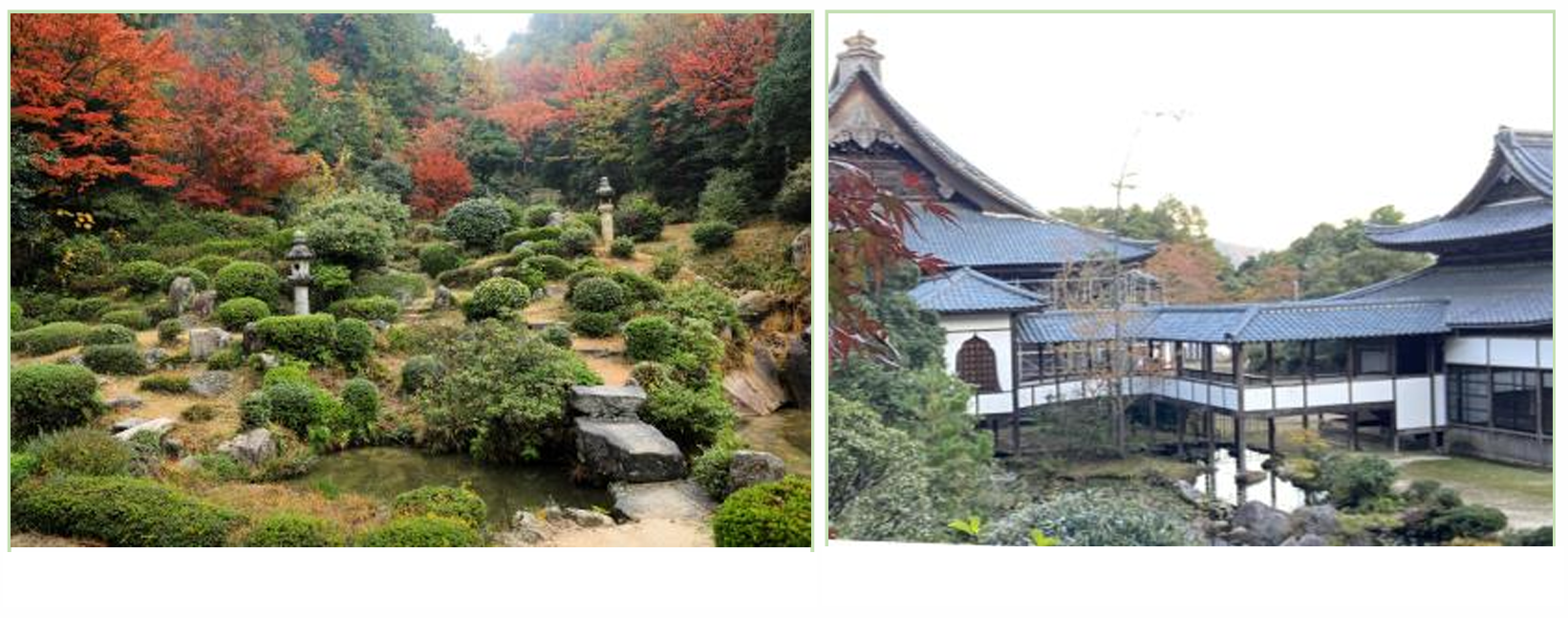


【waterfall 】Represnts Buddhist paradise.

【Hallway】Represents Shishu (the four teachings)


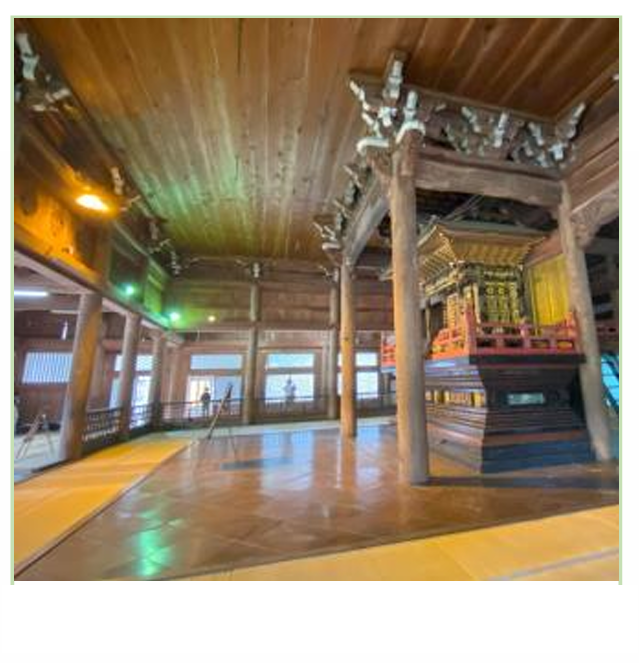
五、 The Seamless Ceiling of Miei-do Hall


Miei-dou was built in 1811 and has since been
designated as a National Important Cultural Property and
Japanese Heritage.

The imposing building has a beam length of 14 ken and a girder length of 13.5 ken, and its large ceiling is made of a uniquely long single board (15 m long) with no joints.
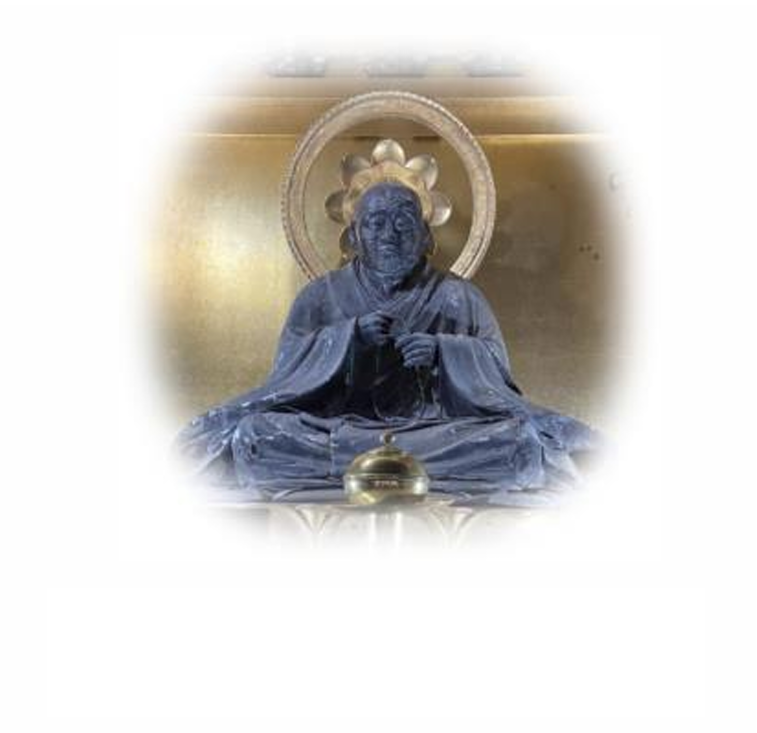


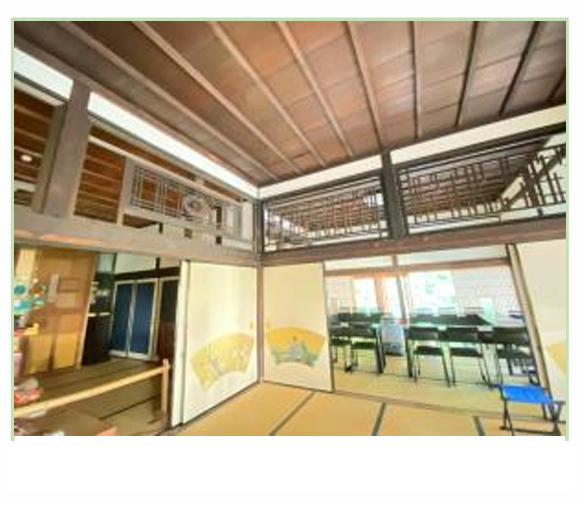
六、The Ceiling and Transom(ranma) Drawing Room


 The Shoin Drawing room was built during the Keicho era(1596-1598) at the behest of Lord Hideyasu Yuki.Hideyasu Yuki and Tadanao Matsudaira (the second lordof the Fukui domain) enjoyed Noh performances.in the Shoin


 It is said that the ceiling was completed in onenight to improve the acoustics duringNoh performances. Each of the rooms, fromthe first to the third, as well as the Buddha room,has a different ceiling height and balustrade, acharacteristic construction that takes acoustic effects intoconsideration.


七、The Mitsuba-aoi Family Crest


 Because Hideyasu Yuki’s son Don’eiShonin (grandson of Ieyasu Tokugawa)inherited the position of 21st chief priest,along with its title of “Koshi-no.Shurei”, it was also permitted to use the15-petalled three-leadhollyhock crest.